Stir Bar Sorptive Extraction (SBSE)
For over 25 years, stir bar sorptive extraction (SBSE) has offered analytical scientists a robust, solvent-free extraction technique for a variety of applications, from beverage profiling to extractables and leachables testing.
SBSE enriches analytes from liquid and solid samples in immersive and headspace extractions. Due to its large sorptive phase volume, the technique provides low detection limits for trace-level analysis.
The Role of PDMS in SBSE
Polydimethylsiloxane (PDMS), a non-polar phase for traditional VOC and SVOC applications, is the established SBSE standard and especially useful for extracting hydrophobic compounds. However, labs requiring more comprehensive chemical profiling may benefit from additional phases to capture a wider analytical range, including polar compounds.
To meet the needs of these labs, GERSTEL now offers four new Twister sorbent phases: CWR/PDMS, HLB/PDMS, DVB/PDMS, and CWR/DVB/PDMS.
How Sorbent Phase Selection Affects Analyte Coverage
Because compounds have varying affinities for different sorbent chemistries, phase selection can influence which analytes are preferentially extracted from a sample. For labs looking to expand their extraction range beyond non-polar compounds, the new Twister phases provide multiple options to broaden analyte coverage and obtain more comprehensive chemical profiles.
Phase Selection Considerations
Phase selection depends on the application and analytical requirements. The following questions can be helpful to ask when evaluating which phase option is best suited to your needs:
- Are you performing targeted or non-targeted analysis?
- Are you looking for a specific compound class or a broader range of compounds?
Case Study: Chemical Profiling of Lemon-Lime Beverages
In a recent study (AppNote 315), GERSTEL scientists used three Twister phases for comparative profiling of four lemon-lime sodas. They evaluated how each phase represented the beverage matrix and whether SBSE could differentiate the samples by brand and formulation.
The table below shows the overall extraction performance of the selected phases—PDMS, HLB/PDMS, and CWR/DVB/PDMS.
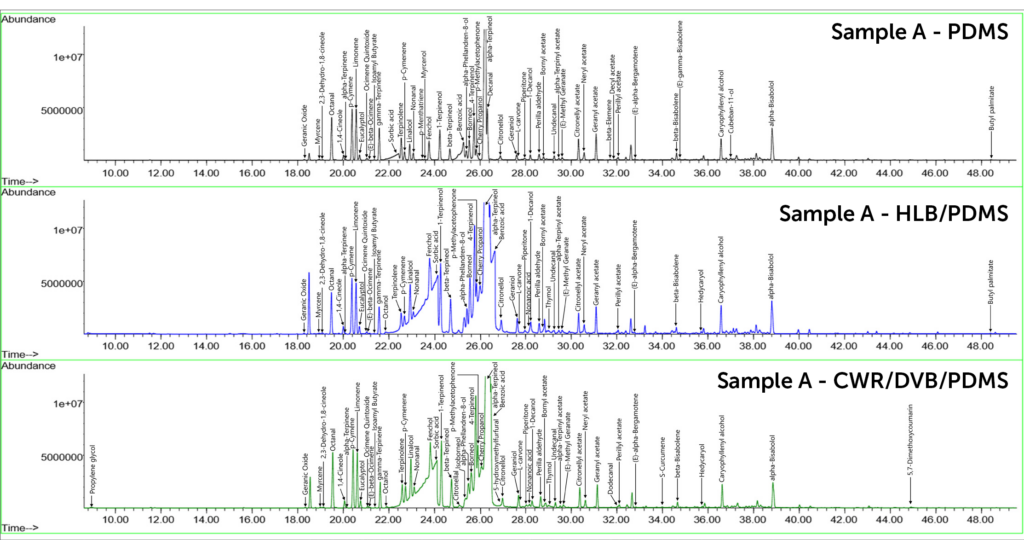
HLB/PDMS offered the highest total GC-MS response and broadest chemical coverage, particularly for polar to moderately polar compounds. CWR/DVB/PDMS provided similarly broad coverage but with complementary selectivity and a lower overall response. In comparison, PDMS produced the lowest total signal and slightly fewer detected compounds but provided the best repeatability and a more selective profile of hydrophobic citrus aroma compounds.
Overall, the complementary data provided by the different phases resulted in a more complete chemical profile of the lemon-lime sodas. PDMS did not extract certain oxygenated, acidic, or processing-related compounds, including furfural, nonanoic acid, decanoic acid, p-menthane-1,8-diol, and β-eudesmol, due to their polarity. HLB/PDMS recovered several of these compounds, while CWR/DVB/PDMS provided distinct selectivity.
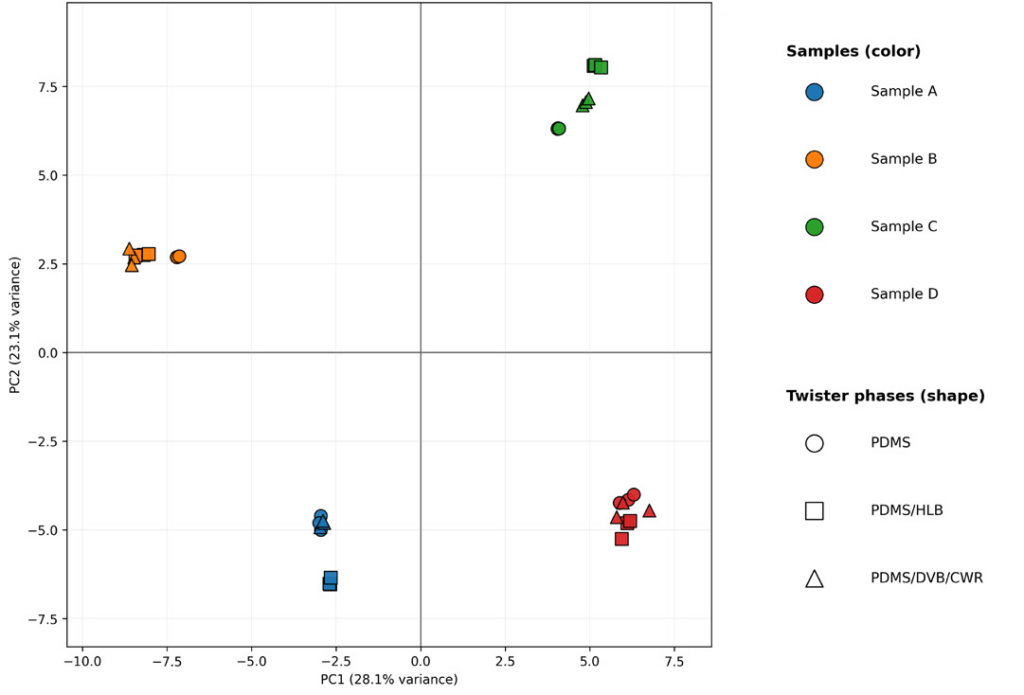
A PCA score plot showed clear separation between the samples, demonstrating SBSE-GC-MS’s ability to distinguish the lemon-lime sodas based on their chemical profiles.
Choosing the Right Twister Phase for Your Application
For analytical scientists who need to extract polar and semi-polar compounds from complex matrices, the new Twister phases offer options for expanding analyte coverage in SBSE workflows. While PDMS may still be sufficient for specific applications or selective profiling of hydrophobic compounds, additional phases enable broader chemical profiling.
Ultimately, the optimal phase or combination of phases depends on the target analytes and analytical goals. All GERSTEL Twister sorbent phases are available for both manual and automated SBSE, allowing scientists to optimize the approach for their workflows. For comprehensive screening, multiple Twister phases may provide useful complementary information when deeper profiling is required.