
Blogs

Automated Vacuum In-Tube Extraction (V-ITEX): Improving VOC and SVOC Analysis in Complex Food, Flavor, and Biological Matrices

The Challenge of Comprehensive VOC Profiling

VOC determination is performed widely for food, beverage, flavor, fragrance, and metabolomics applications in analytical chemistry. For complex matrices such as cheese, chocolate, or biological fluids, comprehensive VOC profiling can be difficult to achieve.

These matrices contain a wide range of compounds, including volatile organic compounds (VOCs) and semi-volatile organic compounds (SVOCs), many of which are present at low concentrations. When seeking a suitable extraction method for VOC and SVOC analysis, scientists must consider an approach that provides accurate, effective recovery across a broad volatility range, particularly for trace-level analytes.

Conventional headspace techniques may provide limited enrichment of semi-volatile compounds or compounds present at low concentrations, making comprehensive profiling more challenging.

Limitations of Traditional Headspace Extraction Techniques

While traditional headspace techniques offer several advantages for food, beverage, flavor, and biological matrices, such as simplicity, ease of use, and solvent-free operation, they also have limitations.

Many commonly used techniques are equilibrium-based and do not provide exhaustive extraction of analytes. As a result, they may provide more limited extraction of certain SVOCs and polar analytes, particularly in complex matrices [1].

Headspace solid-phase microextraction (HS-SPME)

This is a widely used technique in which volatile compounds partition from the sample into the headspace and are extracted onto a coated fiber prior to GC analysis. Due to prolonged heating and extraction times, HS-SPME methods may contribute to artifact formation, changes in molecular structure, or sample degradation under certain conditions [2].

Given these challenges, a more robust and comprehensive extraction technique may be needed to preserve sample integrity while capturing a broad range of volatile compounds.

How Does Vacuum-Assisted Extraction Work?
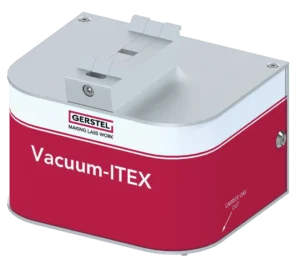
To address these challenges, a relatively new VOC extraction approach was developed by Agroscope (Switzerland) [2] and automated by GERSTEL and CTC Analytics.

The GERSTEL Vacuum In-Tube Extraction (V-ITEX) uses gentle, vacuum-based extraction to transfer VOCs from the sample matrix to a sorbent trap. Under reduced-pressure conditions, analyte boiling points decrease, making them more readily available in the headspace and more readily drawn onto the sorbent, resulting in improved extraction efficiency compared to conventional static headspace techniques [2].
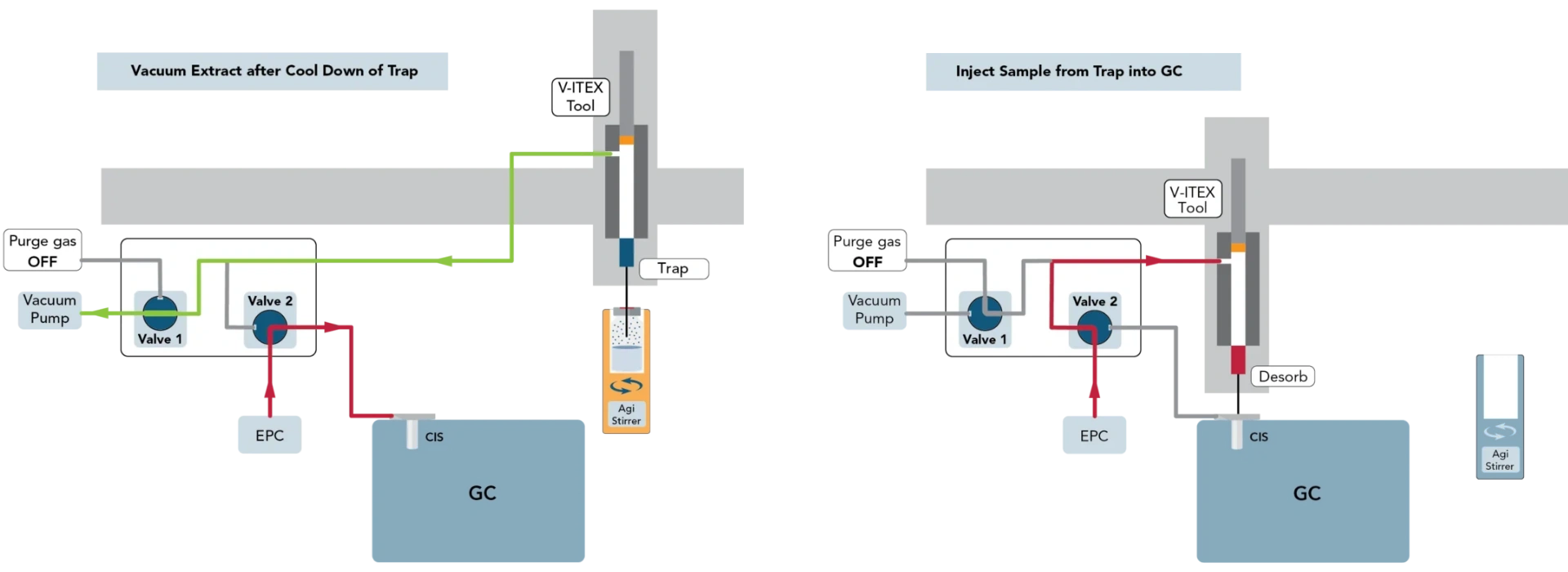
Diagrams of the GERSTEL V-ITEX

The system is fully automated through the GERSTEL MultiPurpose Sampler (MPS), enabling reproducible extraction conditions and unattended operation.

What Advantages Does V-ITEX Provide?

Compared to HS-SPME, V-ITEX offers several notable advantages, including:

Improved Extraction Efficiency – This controlled vacuum approach extracts analytes efficiently while limiting matrix effects and improving the transfer of compounds from complex matrices to the sorbent trap [2].

Lower detection limits – In the original method development study, signal intensities for some compounds were reported to be up to 450 times greater than those obtained using HS-SPME under the same extraction conditions [2].

Comparison of chromatographic responses obtained using V-ITEX (VTT), ITEX, and HS-SPME in the 2019 method development study.
For most compounds, V-ITEX produced substantially higher signal intensities [1].

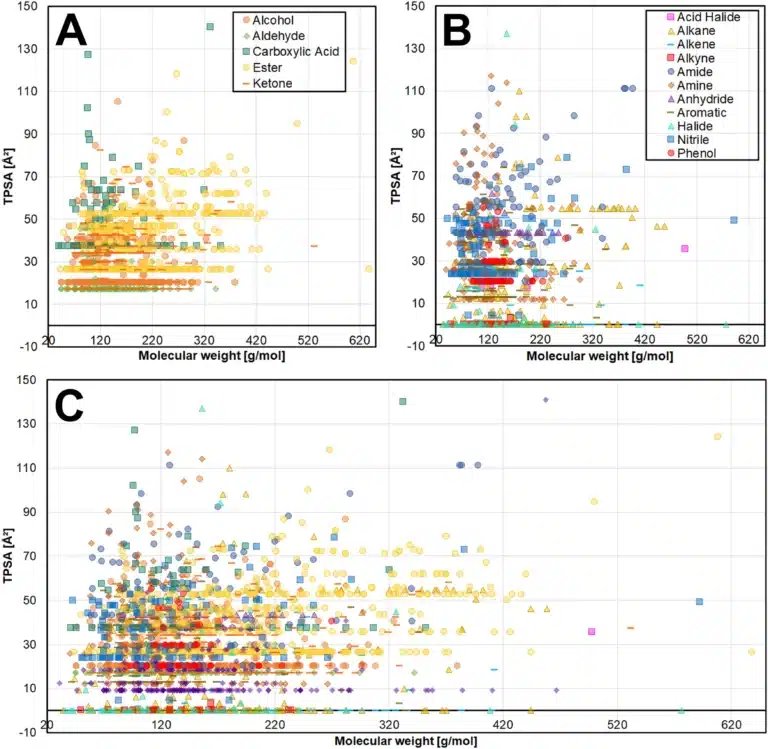
Broad Compound Coverage – Published studies have demonstrated the applicability of V-ITEX across compounds spanning a broad range of molecular weights and polarities, supporting comprehensive VOC and SVOC profiling in complex matrices [1].

Automation and Reproducibility – The fully automated workflow enables controlled extraction conditions, reproducible results, and seamless integration with the GERSTEL MPS platform.

Real-World Applications of V-ITEX

Since its original development for complex food matrices, V-ITEX has been applied to a variety of analytical applications, including nutrivolatilomics, biological sample analysis, breath analysis, and aroma profiling.

Chocolate Aroma Profiling

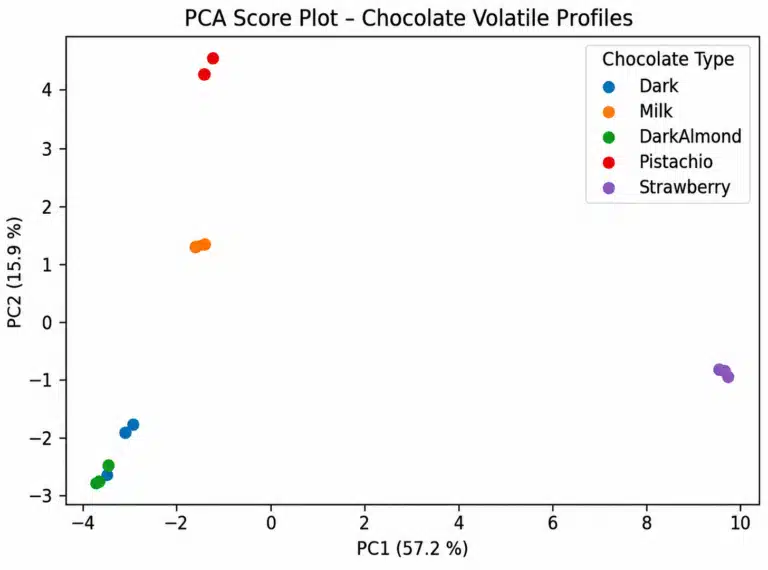
A recent GERSTEL study (AppNote 311) used V-ITEX to profile volatiles and differentiate five chocolate formulations: dark, milk, dark almond, pistachio, and strawberry.

Because chocolate is a lipid-rich matrix containing compounds across a broad volatility range, comprehensive profiling can be challenging. V-ITEX enabled efficient extraction of both volatile and semi-volatile compounds, supporting broad compound coverage with reliable results.
Study Results

The PCA score plot revealed clear differences between the chocolate types, while the tight clustering of triplicate injections demonstrated high analytical reproducibility.

PCA score plot of five different chocolate volatile profiles

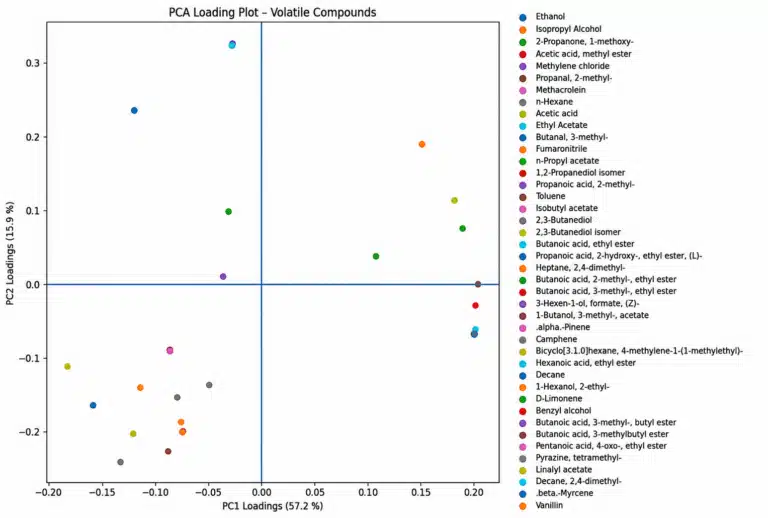
V-ITEX enabled the profiling of a broad range of volatile and semi-volatile compounds across the chocolate samples, including esters, alcohols, organic acids, aldehydes, ketones, terpenes, sulfur compounds, and pyrazines. These compounds contributed to the observed differences between the chocolate formulations and supported the PCA-based differentiation of dark, milk, dark almond, pistachio, and strawberry chocolates.

PCA loading plot of volatile compounds

Additional Applications

Nutrivolatilomics

Researchers have also applied V-ITEX to nutrivolatilomics studies involving plasma and urine samples, in which more than 2,000 compounds were detected in plasma and more than 1,200 in urine after dairy and soy intake [3]. These studies demonstrated the potential of V-ITEX for dietary biomarker discovery and metabolomics applications.

Off-Odor Analysis

V-ITEX has also been used in Swiss Raclette cheese aroma analysis with GC-O/MS, where it helped identify compounds responsible for malty off-flavors and link them to fermentation pathways [4].

Breath Analysis
More recently, researchers applied V-ITEX to breath analysis, detecting between 1,174 and 1,312 VOCs in dairy cow breath samples [5].
Together, these studies demonstrate the versatility of vacuum-assisted extraction across a wide range of applications.

Application space of V-ITEX based on compounds reported in published studies.
The tutorial review highlights successful application of V-ITEX across compounds spanning a broad range of molecular weights and polarities,
demonstrating its suitability for comprehensive VOC and SVOC profiling across diverse analytical applications [1].

Conclusion

The GERSTEL V-ITEX provides a robust and highly reproducible solution for VOC analysis, improving extraction efficiency, broadening VOC and SVOC coverage, and limiting matrix effects.

For analytical chemists who value precision, accuracy, and reproducibility in their workflows, automated vacuum-assisted extraction can be a valuable addition, particularly when working with complex food, beverage, flavor, fragrance, and biological matrices.

References

  1. Tintrop, L. K., Wacker, S., Kopiec, F., Cretnik, S., & Fuchsmann, P. (2026). Vacuum in-tube extraction (V-ITEX): A tutorial review of theoretical principles, operational parameters, and applications. Analytica Chimica Acta. https://doi.org/10.1016/j.aca.2026.345539 
  2. Fuchsmann, P., Tena Stern, M., Bischoff, P., Badertscher, R., Breme, K., & Walther, B. (2019). Development and performance evaluation of a novel dynamic headspace vacuum transfer “In-Trap” extraction method for volatile compounds and comparison with headspace solid-phase microextraction and headspace in-tube extraction. Journal of Chromatography A, 1601, 60–70. https://doi.org/10.1016/j.chroma.2019.05.016
  3. Fuchsmann, P., Tena Stern, M., Münger, L. H., Pimentel, G., Burton, K. J., Vionnet, N., & Vergères, G. (2020). Nutrivolatilomics of urinary and plasma samples to identify candidate biomarkers after cheese, milk, and soy-based drink intake in healthy humans. Journal of Proteome Research, 19(10), 4019–4033. https://doi.org/10.1021/acs.jproteome.0c00324
  4. Meng, Y., Fuchsmann, P., Badertscher, R., Breme, K., Bischoff, P., Schlichtherle-Cerny, H., Delmonte, P., & others. (2021). Formation of 3-methylbutanal and 3-methylbutan-1-ol recognized as malty during fermentation in Swiss Raclette-type cheese. Journal of Agricultural and Food Chemistry, 69(2), 717–729. https://doi.org/10.1021/acs.jafc.0c06570
  5. Eichinger, J., Reiche, A.-M., Dohme-Meier, F., & Fuchsmann, P. (2024). Optimization of volatile organic compounds sampling from dairy cow exhaled breath using polymer-based solid-phase extraction cartridges for gas chromatographic analysis. Journal of Breath Research, 18(3), 036001. https://doi.org/10.1088/1752-7163/ad38d5

Learn More about the GERSTEL V-ITEX: